Guide · Headaches and neck

5 reasons you get tension headaches — and what to do about them

That tight band around your forehead is rarely one big problem. Usually it's five small ones.

Dr. Eleanor Whitcombe
By Dr. Eleanor Whitcombe
Sleep & Wellness Editor · 6 min read
Updated August 31, 20261 Deal

Summary: If you know the tight band of pressure around your forehead that turns up day after day, you're far from alone — tension headaches are the most common form of headache there is. And the pain often begins somewhere other than where you feel it: in your neck. Here are the five most common causes, and what to do about each one.

A person at a desk seen from behind with both hands clasped behind a stiff neck
Find some ease
Bring the screen to eye levelGuide

1. Your screen pulls your head forward

Your head weighs around 11 pounds when it sits balanced on top of your spine. But every degree you tip it toward a screen multiplies the load on your neck — at just 15 degrees of forward tilt, the pull is already the equivalent of more than 27 pounds. The muscles across your neck and shoulders work overtime hour after hour, and that tension refers the pain up over the back of your skull and forward toward your forehead.

Tip: Bring whatever you're looking at up to eye level — screen and phone both. And give your neck a break several times an hour: stand up, look off at the horizon, and let the muscles let go.


A person holding the back of their neck with visible tension
Find some ease
When your shoulders creep toward your earsGuide

2. Stress settles in your neck and shoulders

When you're under pressure you pull your shoulders toward your ears without noticing, and clench through the jaw and neck. You usually only catch it once the day is over — by which point the muscles have been holding that tension for hours. Sustained muscle tension of exactly this kind is the classic trigger for a tension headache.

Tip: Build in short, deliberate breaks. Roll your shoulders, unclench your jaw, take three slow breaths every hour. It sounds trivial, but it interrupts the tension before it reaches your head.

A woman at her desk mid-morning with her fingers pressed to her temple
The pressure band
The pain starts in the neckGuide

3. Tight neck muscles press on a nerve

A tension headache is felt across the forehead and temples, but it often starts in the neck. Nerves run from the top vertebrae up over the back of the skull and all the way forward to the brow. When the muscles around them are tight, those nerves get irritated — and the result is that familiar band of pressure that tends to show up mid-morning. You might blame the screen or the coffee, but the pain was set in motion long before.

Tip: Heat on the neck, gentle stretches and slow circles with your head loosen the muscles around those nerves. Notice whether the headache changes when you press the muscles at the very top of your neck — if it does, you've found a real part of the explanation.

A woman reaching for a pill bottle on the kitchen counter with one hand at her temple
Symptom or cause?
The pill dulls it — it doesn't solve itGuide

4. You're treating the symptom, not the cause

A pill dulls the pain for a couple of hours, and then it's back. That cycle can run for years without getting you any closer to a fix. Frequent use of over-the-counter painkillers can also produce what doctors call medication-overuse headache — where the painkillers themselves help keep the headache going.

Tip: Use painkillers deliberately — as a rule of thumb, no more than a couple of days a week. If the headache returns day after day, go looking for the cause instead of increasing the dose, and talk to your doctor if it won't lift.

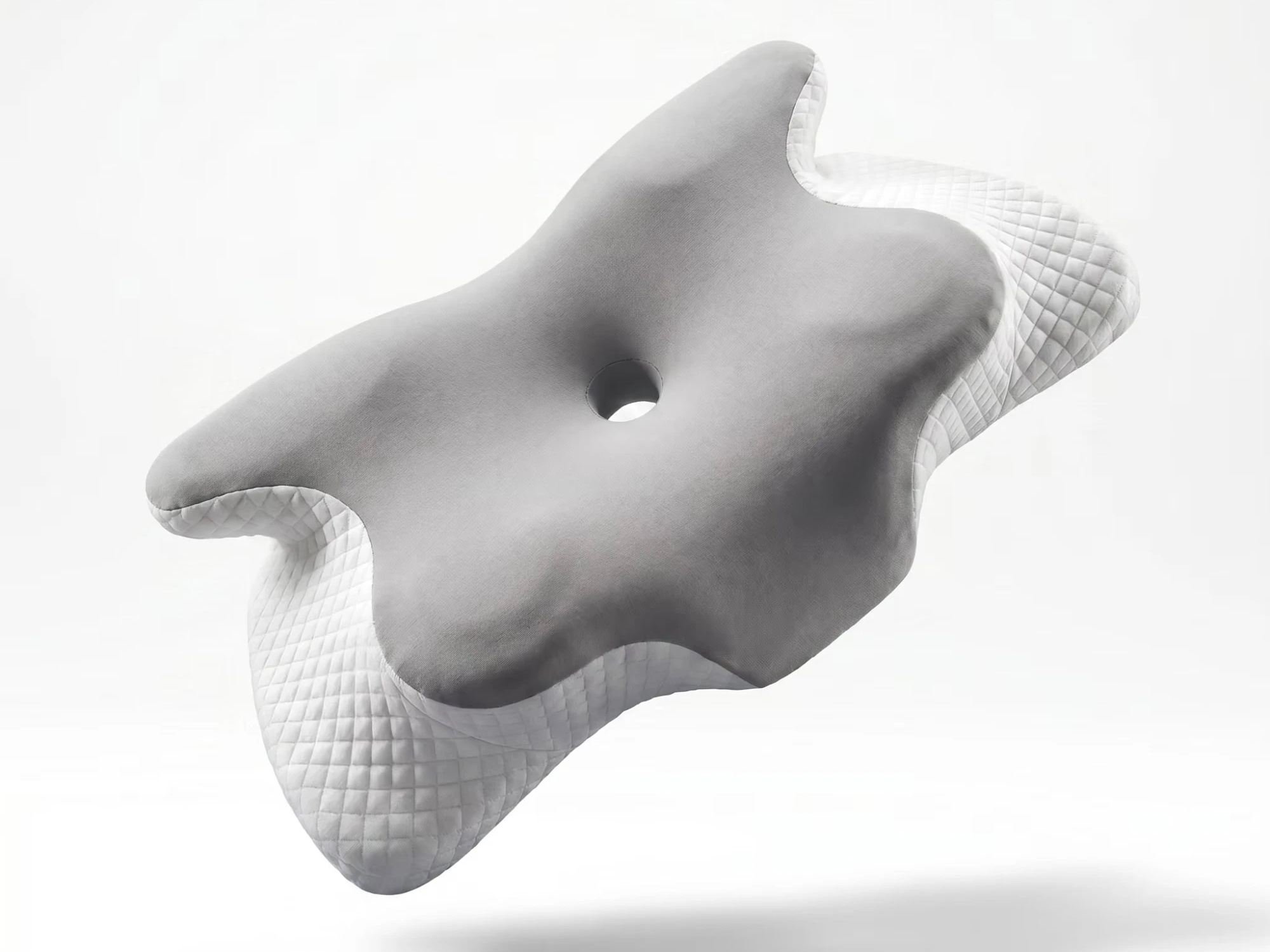
Proper support all night
The Sleepr Ergonomic PillowGuide

5. Your pillow lets your neck sag all night

Here's the one most people overlook. Your neck curves forward naturally — and a flat or worn-out pillow leaves a gap underneath that curve. The small muscles in your neck then hold your head up all night, and you wake up tight long before the day has even started. The fix is an ergonomic pillow that fills the neck's curve and lets those muscles switch off completely — and in our testing, The Sleepr Ergonomic Pillow did that best in its price range.

Tip: A pillow with the right shape supports your neck on your back and on your side. When the muscles actually rest overnight, the headache has far less to feed on during the day.

Plenty of people wake up already tight in the neck

A headache that shows up morning after morning is often set in motion overnight. The right support makes it straightforward to give your neck some rest — and let the day start without the pressure band.

4.8 out of 5 · based on 5,832 reviews

The Sleepr Ergonomic Pillow on a made bed
30-night trialFor tension headaches

Make your mornings pain-free again

Made for anyone who wakes up tight in the neck — or who knows the headache that arrives morning after morning.

$59.99
See the pillow →

Trial period: 30 nights

Free 30-night returns

Most people notice a difference within the first week.

Dr. Eleanor Whitcombe
Reviewed by
Dr. Eleanor Whitcombe
Sleep & Wellness Editor · 14 years in sleep research

Eleanor has a PhD in sleep medicine. She spent seven years at the Stanford Sleep Medicine Center before joining The Health Bulletin. Her work has appeared in the Journal of Clinical Sleep Medicine and Sleep. She takes no money, no free samples, and no affiliate cuts from the brands she reviews.

Disclosure: The Sleepr Ergonomic Pillow is sold by a brand that helps fund The Health Bulletin. We say so out loud because trust matters more than money. We bought and tested every product on this list ourselves. No brand sees our reviews, scores, or rankings before they go live. Read our editorial standards here.